
Growing Competition in Commercial Vehicle Space
www.chinatrucks.com: Commercial vehicles may not be the most glamorous of topics, especially in comparison to cars, but have still seen some interesting action in the Indian market.
Three decades ago, the Japanese quartet of Toyota, Nissan, Mazda and Mitsubishi entered the light commercial vehicle (LCV) space. They teamed up with local companies in a business model which was similar to two-wheelers.
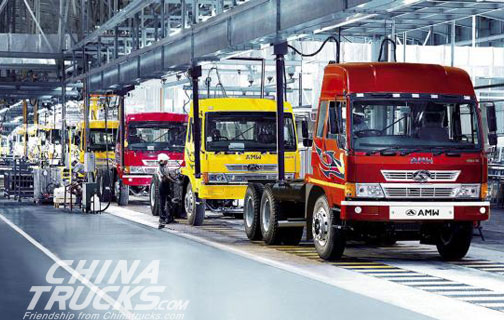
In this case, the LCV script saw DCM and Toyota coming together, while Mitsubishi went along with Eicher. Mahindra & Mahindra teamed up with Nissan and Swaraj with Mazda. The stage was set for a keen tug-of-war in an arena where Telco (before it was rechristened Tata Motors) was the clear leader and Ashok Leyland its nearest rival.
Tribute to hard work
Naturally, expectations were high in the market and it would have seemed perfectly natural at that point in time to assume that the Japanese would triumph given their global standing. Yet, nobody reckoned with the Tata 407 which stormed the market and literally relegated the newcomers to the sidelines.
It was not the easiest of tasks for Telco to create a product that would take on the might of these Japanese companies. The fact that it did, and enormously successfully at that, was a tribute to the hard work put in creating processes, ensuring high levels of cost-control and carrying out extensive market research.
The Japanese lost out primarily because spares for their products were expensive. The Tatas, on the other hand, had focused on localisation because they were only too aware that the 407 would have to withstand the rigours of Indian roads. Naturally, operators opted for the Tata product because it turned out to be the more viable model in a business where fuel and operating costs hold the key to survival.
The 407 was an important victory for the Tatas and reinforced their leadership standing in the truck segment. It was also clear that LCVs promised plenty and, unlike their medium and heavy counterparts, were a more comfortable option for operators. To that extent, they were less vulnerable to the cyclical vagaries which characterise the CV space.
The next big move for Tata Motors was to occur over a decade later, in 2003, when it snapped up Daewoo Commercial Vehicles in Korea. By this time, the group was keen on drafting a global script for its various companies. The Daewoo buyout was part of this vision and gave Tata Motors a foothold in new markets. It later bought out a stake in Hispano, a Spanish bus-body builder, which eventually led to a complete buyout. Tata Hispano, like Daewoo, is now an important arm of Tata Motors.
Ace move
The other big revolution was now set to unravel in the form of the petite Ace which literally redefined the cargo pickup segment. Till then, operators had to make do with three-wheelers which more than met their needs for small distances. The Ace reminded them what an extra wheel and smart cabin could do to enhance their sense of well-being. Like the 407 in the mid-80s, the Ace took off with a bang and continues to clock impressive numbers.
Competition was quick to recognise its potential and it was only a matter of time before M&M, Piaggio and Ashok Leyland (with Nissan) followed suit. Today, these pickups are doing good business at a time when the Indian truck market is seeing its worst slowdown in recent times. The fact that road connectivity has also improved in recent times is another reason for the pickup success story which began with the Ace.
New players
Tata Motors continues to be the leader across heavy, medium and light trucks but the arena is now seeing more competition. Of these, Daimler could be the one to watch out for. The company, whose trucks and buses are retailed under the BharatBenz umbrella, is planning a blitzkrieg of products in the coming years which are expected to follow the Tata business model of competitive costing. Observers believe Daimler is working to a careful plan though it remains to be seen how quickly this will affect leadership stakes.
Ashok Leyland was slow to enter the LCV space but the tie-up with Nissan could see the company make up lost ground. Likewise, M&M recently pick up Navistar’s stake in its truck joint venture and is confident of steering the business on its own. It is giving itself three years to stage a turnaround where its market share should ideally jump three-fold to nine per cent.
Eicher is the other local player which now has Volvo as the equity ally in its truck business. Similarly, Asia MotorWorks operates in the heavy truck space ranging from 25-49 tonnes. Chinese players such as Beiqi Foton and a handful of others are also tipped to enter the segment. It will be interesting to see how market shares will pan out during the course of this decade.
Volvo & bus space
On the subject of commercial vehicles, the story will not be complete without a mention of Volvo and the impact of its brand in the luxury bus space. What started off as an initiative on the Mumbai-Pune route has now become the most fashionable mode of travel. The expressway, doubtless, played a big role in enhancing connectivity but the fact that the Volvo bus put the heat on trains connecting these two cities is no small matter. Today, Volvo is synonymous with premium bus travel and is the best bet for intercity travel across India. In the process, it has prompted companies such as Mercedes and Scania to join the bandwagon while reminding established players such as Tatas and Leyland to push the envelope.
Views:0

Submit Your Requirements, We Are Always At Your Service.
- Invitation to Visit: 2025 China Commercial Vehicle Show (CCVS) 2024-04-17
- Bangladesh: JAC T8 Made Its Debut on Dhaka Commercial Automotive Show 2022 2022-07-19
- Yutong's New Energy Commercial Vehicle Base Project Kicks Off 2022-07-07
- China Sold 357,000 Units Commercial Vehicles in October 2019-12-04
- China Commercial Vehicles Show (CCVS) 2019-05-10
- ZF: China Commercial Vehicle Has Huge Market Potential 2018-08-01
- JAC Whole Series of Products On Display at China Commercial Vehicle Show 2017-11-07
- 2017 China Commercial Vehicle Show Ready to Set New Trends 2017-11-03
- Many New Products to Make Their Debut at China Commercial Vehicles Show 2017 2017-10-27
- Sales of New Energy Commercial Vehicles Rose by 79.4% in July 2017-08-21
- Visiting Invitation: See What's New from Renault Trucks at IAA 2026
- China's Heavy Truck Exports Surge in June as Leading Brands Win Major Orders
- JAC Becomes Official Vehicle Partner of Ghana Football Association
- Xuzhou Launches International Communication Center to Boost Global Outreach
- FOTON, COSCO Shipping Launch Joint Venture to Strengthen Global Supply Chain
- Foton, COSCO Shipping Move to Secure Capacity as China’s CV Exports Rise
- The 11th DISCOVERY TRUST Awards Successfully Held in Beijing, China
- Chinese Heavy Truck Makers Shift to Value-Driven Global Expansion
- Shandong Heavy Industry and Kazakhstan’s Karaganda Region Ink New Deal
- China’s Diesel Trucks are Shifting to Electric
- China's New Energy Tractor Truck Sales Rise 97% to 25,000 Units in June
- China's Pickup Truck Sales Continue to Decline in May
- China's Tractor Truck Sales Up 27% in May
- China's Medium-Duty Truck Market Surges 74% in May
- China's Mini Truck Sales Drop 18% YoY in May
- China's Heavy Truck Sales Rise 23% in May
- China's Light Truck Market Grows 7% to 172,000 Units in May
- China’s Pickup Truck Market Posts Steady Sales Growth in April
- China Light Truck Sales Down 2% to 178,100 Units in April 2026
- China Heavy-Duty Truck Sales Hit 117,000 Units in April, Up 33% YoY