TuSimple Expands as It Readies Self-driving Truck Technology
Though it will likely be a decade or more before commercial trucks roll down the road without human drivers, trucks with sophisticated, semiautonomous driving systems will soon be on the street — with a person aboard to supervise.
TuSimple, a Chinese-based startup company that set up a research and test center in Tucson last year, is moving fast to make that happen.
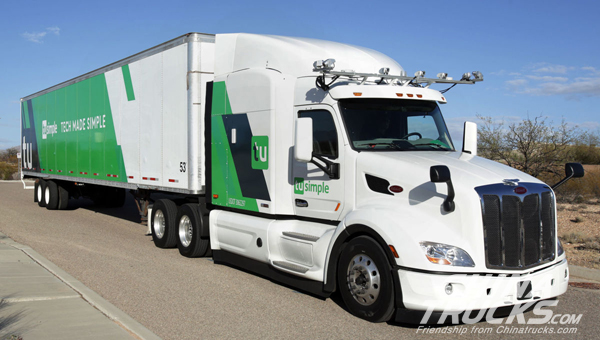
The company has moved into larger quarters on Tucson’s southeast side as it ramps up toward road tests of its semiautonomous trucks later this year.
After finding its initial site off West Grant Road and Interstate 10 too small for its purposes, the company moved to a new facility on Old Vail Road in early February, said Chuck Price, a TuSimple partner and vice president of product.
The property, consisting of a 50,000-square-foot industrial building on about eight acres, formerly was occupied by a maker of sheet-metal ductwork and features high bay areas the company needs for its growing fleet of test trucks.
TuSimple, which has dual headquarters in Beijing and San Diego, plans to build out offices and labs at the new Tucson site and eventually hire about 90 employees here to focus on production development of its autonomous truck systems, Price said.
The company already has nearly 200 employees in all, including 60 at its research facility in San Diego and more than 100 in Beijing, Price said.
TuSimple has key partnerships with companies including graphics-card maker Nvidia, which makes programmable vehicle control boards, and Texas-based truckmaker Peterbilt Motors Co.
The company has raised more than $80 million in funding since 2015 from investors including Chinese internet giant Sina Weibo and Nvidia.
But TuSimple also has some significant competition in the emerging self-driving truck industry.
Truckmakers including Volvo and Daimler have been involved in semiautonomous truck research for years, with Daimler unveiling a self-driving Freightliner truck back in 2015.
Ride-sharing service Uber bought into a self-driving truck startup that delivered a load of beer across Colorado in 2016, and Google spinoff Waymo is working on autonomous trucks as it tests self-driving ride-sharing vans in the Phoenix area.
In November, Elon Musk’s Tesla unveiled an electric-powered truck with a semiautonomous autopilot system.
THE ROAD AHEAD
Despite all the development work, self-driving trucks still face significant technical, political and regulatory challenges.
Major industry groups such as the American Trucking Association have urged caution, citing safety concerns and the lack of interstate regulations.
The Teamsters Union vehemently opposes self-driving truck regulations, citing safety concerns and the potential loss of thousands of jobs, and the union has helped stymie pending autonomous-vehicle legislation in Congress.
TuSimple’s Price acknowledged that it may be years before self-driving trucks are allowed to operate without human backup in all conditions — known as Level 5 autonomy.
But in the meantime, Price said TuSimple hopes new regulations will allow the company to offer Level 4 autonomous driving — allowing the use of self-driving trucks mainly on highway stretches — with a “driver supervisor” present but not always in control.
Though that won’t save trucking companies the cost of a driver, it could provide benefits in safety, logistics and fuel economy, said Price, who before joining TuSimple led engineering and technical operations for a California company developing systems to allow trucks to “platoon” down the highway.
“We think there will still be plenty of opportunities for drivers, and driving in conditions that are more healthy, that keep drivers home at night so they’re not stuck out in the middle of nowhere, and ideally in cases where they’ re not driving at night,” he said.
“The other aspect is, when you have a driver in the vehicle, you effectively have a much safer driving environment, because you have a system that’s fully capable of handing the vehicle, doesn’t get sleepy, and you have a driver who has a partner at all times.”
TuSimple has already successfully conducted some long-distance testing, last July completing a 200-mile Level 4 test drive from San Diego to Yuma using an Nvidia graphics-processing unit and cameras as primary sensors.
Rather than sell its systems, TuSimple plans to offer semiautomated hauling services. The company is in talks with shippers to carry its first commercial load on the roughly 120-mile route from Tucson to Phoenix by late spring, Price said.
The company has three Peterbilt 579 semi-trucks with three more on the way, and plans a fleet of 25 trucks to eventually serve the region, he said.
To create its robo-trucks, TuSimple strips out the sleeper-cab beds from the trucks and installs computer servers connected to cameras and sensors on the outside of the rigs, with seating for two test engineers.
Unlike most other systems that rely heavily on Lidar — a form of radar using pulsed lasers — TuSimple’s system mainly uses advanced camera technology to recognize roadways and obstacles. The company maps the routes its trucks will run using passenger cars fitted with Lidar, cameras and other sensors.
All that technology takes talent to develop, so TuSimple has been busy hiring electrical, mechanical, software and system engineers.
While many of its engineers have come from China or California, the company is looking to establish a strong relationship with the University of Arizona, Price said.
Last fall, the company hired UA engineering grad Xinyi Xu as an autonomous driving operation and test engineer. Xu received a master’s degree in systems engineering in 2017.
Xu said he was happy to find the opportunity at TuSimple and stay in Tucson, where he completed a bachelor’s degree in industrial engineering at the UA in 2015.
Larry Head, acting dean of the UA College of Engineering and director of the UA’s Transportation Research Institute, said TuSimple has given presentations to students about the company’s work and actively pursued some students.
TuSimple’s presence on the cutting edge of autonomous vehicle research offers UA students compelling new opportunities in the field, he said.
“It’s something that’s very exciting to the students, having access to an emerging technology area,” Head said. “I’m glad we’re in a good place to be part of it.” (www.chinatrucks.com)
Views:0

Submit Your Requirements, We Are Always At Your Service.
- TuSimple's Self-Driving Trucks to Deliver Mails for the US Postal Service 2019-05-27
- Tusimple to Bring Autonomous Truck Total to 40 by June 2019 2019-01-08
- TuSimple Becomes First in China to Get Nod to Road Test Driverless Trucks 2018-10-22
- TuSimple’s Autonomous Trucks Can See 1,000M And That Could Be A Game-Changer 2018-09-12
- TuSimple and Shacman Jointly Create X6000 Driverless Container Truck Fleet 2018-04-08
- Autonomous Trucks to Haul Cargo in Arizona 2018-01-23
- Autonomous Trucks from TuSimple, Peterbilt Attract Public Attention at CES Show 2018-01-12
- Beijing-Based Tusimple Racing Tesla Brings Driverless Trucks to Arizona 2017-09-08
- China Paving a Way for Autonomous Trucks 2017-01-05
- Weichai Wins National Science and Technology Award for Diesel Engine Technology 2026-07-14
- Visiting Invitation: See What's New from Renault Trucks at IAA 2026
- China's Heavy Truck Exports Surge in June as Leading Brands Win Major Orders
- JAC Becomes Official Vehicle Partner of Ghana Football Association
- Xuzhou Launches International Communication Center to Boost Global Outreach
- FOTON, COSCO Shipping Launch Joint Venture to Strengthen Global Supply Chain
- Foton, COSCO Shipping Move to Secure Capacity as China’s CV Exports Rise
- The 11th DISCOVERY TRUST Awards Successfully Held in Beijing, China
- Chinese Heavy Truck Makers Shift to Value-Driven Global Expansion
- Shandong Heavy Industry and Kazakhstan’s Karaganda Region Ink New Deal
- China’s Diesel Trucks are Shifting to Electric
- China's New Energy Tractor Truck Sales Rise 97% to 25,000 Units in June
- China's Pickup Truck Sales Continue to Decline in May
- China's Tractor Truck Sales Up 27% in May
- China's Medium-Duty Truck Market Surges 74% in May
- China's Mini Truck Sales Drop 18% YoY in May
- China's Heavy Truck Sales Rise 23% in May
- China's Light Truck Market Grows 7% to 172,000 Units in May
- China’s Pickup Truck Market Posts Steady Sales Growth in April
- China Light Truck Sales Down 2% to 178,100 Units in April 2026
- China Heavy-Duty Truck Sales Hit 117,000 Units in April, Up 33% YoY