
Geely Farizon, WeRide Plan 2,000 Robotaxi GXR Deliveries by 2026
Geely Farizon New Energy Commercial Vehicle Group and autonomous driving company WeRide have expanded their strategic partnership and plan to deliver 2,000 Robotaxi GXR vehicles by 2026, the companies announced on March 9.
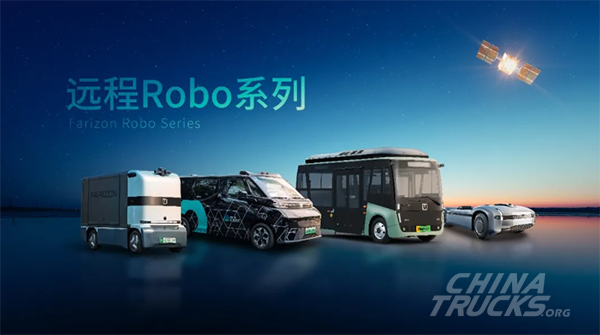
The upgraded Robotaxi GXR will be deployed in both Chinese and international markets, marking a new step toward large-scale global commercialization of autonomous taxi services.
The new-generation Robotaxi GXR is expected to roll off the production line in the third quarter of 2026. The production plan is expected to accelerate the commercial rollout of WeRide’s Robotaxi operations.
As of January 2026, WeRide’s global Robotaxi fleet totaled 1,023 vehicles. With the additional 2,000 units planned for delivery, the company expects its global operational fleet to exceed 2,600 vehicles this year. WeRide is targeting a global Robotaxi fleet of tens of thousands of vehicles by 2030.
The upgraded Robotaxi GXR will feature WeRide’s latest autonomous driving system, GEN8, built around the company’s self-developed Sensor Suite 8.0 (SS8.0).
A key upgrade is a high-resolution lidar sensor capable of detecting objects at distances of up to 600 meters—around two to three times the range of typical industry systems. The system increases point cloud detail by 17 times and allows the vehicle to identify road conditions earlier. According to the company, the longer detection range can provide more than 70 percent additional time for safety decisions during high-speed driving.
The system is designed to detect small obstacles and potential risks more accurately and maintain stable perception in challenging weather conditions such as heavy rain or dense fog, supporting all-weather autonomous driving services.
Production efficiency is also expected to improve. Using Farizon’s AI-by-wire chassis technology along with its supply chain and manufacturing system, the production time for each vehicle is expected to drop from about one hour to less than 10 minutes.
The companies said they are also working to reduce Robotaxi costs. The total cost of the upgraded Robotaxi GXR is expected to decrease by about 15 percent.
Tony Han, founder and CEO of WeRide, said the expanded partnership marks a new phase of cooperation between the two companies.
“Our collaboration is evolving from product development to broader ecosystem cooperation,” Han said. “By combining our autonomous driving technology with Farizon’s manufacturing capabilities, we aim to accelerate the commercial deployment of Robotaxi GXR in markets including China, the Middle East, Southeast Asia and Europe.”
Fan Xianjun, CEO of Geely Farizon New Energy Commercial Vehicle Group, said the partnership supports the company’s transition from traditional manufacturing to intelligent mobility solutions.
“With our R&D capabilities and smart factory production system, we will support the large-scale production and delivery of the GXR model and help advance the commercialization of Level 4 autonomous driving,” Fan said.
The expanded cooperation builds on an existing Robotaxi program between the two companies. In October 2024, Farizon and WeRide introduced the Robotaxi GXR based on the Farizon Super VAN platform.
The vehicle is already operating in cities including Guangzhou, Beijing, Abu Dhabi, Dubai and Riyadh. Public operations are also scheduled to begin in Singapore on April 1 this year.
The Farizon Super VAN platform has entered nearly 30 European markets and won the 2025 International Van of the Year (IVOTY) award. It was the first Chinese vehicle to reach the final stage of the award in its 33-year history.
Earlier this year, Farizon announced its “30111” strategy, targeting annual sales of one million vehicles by 2030. The company aims to become the leading commercial vehicle brand in China and the global leader in new energy commercial vehicles.
Beyond Robotaxi, Farizon’s Robotruck vehicles are already operating in port environments, while Robovan and Robobus models are expected to begin large-scale deployment later this year.
The company plans to develop a broader ecosystem for its Robo vehicle lineup, integrating vehicle technology, manufacturing and operations. As more autonomous vehicles enter real-world applications, large-scale commercial deployment of driverless mobility is expected to accelerate.
Views:0

Submit Your Requirements, We Are Always At Your Service.
- Visiting Invitation: See What's New from Renault Trucks at IAA 2026
- China's Heavy Truck Exports Surge in June as Leading Brands Win Major Orders
- JAC Becomes Official Vehicle Partner of Ghana Football Association
- Xuzhou Launches International Communication Center to Boost Global Outreach
- FOTON, COSCO Shipping Launch Joint Venture to Strengthen Global Supply Chain
- Foton, COSCO Shipping Move to Secure Capacity as China’s CV Exports Rise
- The 11th DISCOVERY TRUST Awards Successfully Held in Beijing, China
- Chinese Heavy Truck Makers Shift to Value-Driven Global Expansion
- Shandong Heavy Industry and Kazakhstan’s Karaganda Region Ink New Deal
- China’s Diesel Trucks are Shifting to Electric
- China's New Energy Tractor Truck Sales Rise 97% to 25,000 Units in June
- China's Pickup Truck Sales Continue to Decline in May
- China's Tractor Truck Sales Up 27% in May
- China's Medium-Duty Truck Market Surges 74% in May
- China's Mini Truck Sales Drop 18% YoY in May
- China's Heavy Truck Sales Rise 23% in May
- China's Light Truck Market Grows 7% to 172,000 Units in May
- China’s Pickup Truck Market Posts Steady Sales Growth in April
- China Light Truck Sales Down 2% to 178,100 Units in April 2026
- China Heavy-Duty Truck Sales Hit 117,000 Units in April, Up 33% YoY