
Driveless Truck to be Regular Presence on Roads in a Decade
While companies ranging from Google offshoot Waymo to established businesses such as Toyota or General Motors work on self-driving passenger cars, truck manufacturers have been quietly developing similar technology.
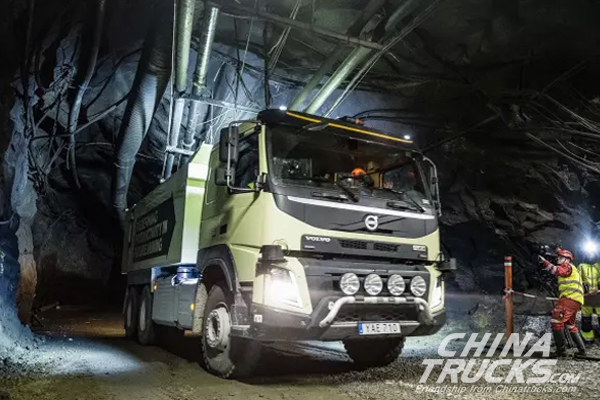
“Driverless trucks could be a regular presence on many roads within the next 10 years,” says José Viegas, former secretary-general of the International Transport Forum (ITF), a think-tank that operates under the umbrella of the OECD, whose members include the world’s richest countries. “Trials on public roads are under way in many regions including the US and the EU. Manufacturers are investing heavily into automation, and many governments are actively reviewing their regulations.”
Volvo Group already has a fully automated truck operating in Kristineberg mine in Sweden. It also recently demonstrated a fully driverless truck in China that can drive between delivery hubs without the need for a human operator.
For truckmakers and their haulage customers, the potential upside from removing drivers is huge in the slim-margin world of shifting goods. Labour accounts for up to 45 per cent of total road freight costs, according to a 2015 study by economic research group Panteia.
But what will become of the vast trucking workforce?
“Self-driving trucks threaten to disrupt the careers and lives of millions of professional truck drivers,” says Steve Cotton, general secretary of the International Transport Workers’ Federation, a global association of around 700 unions representing nearly 20m members from 150 countries.
In a May 2017 report, the ITF predicted that up to 4.4m of the 6.4m professional trucking jobs in the US and Europe could be eliminated by autonomous technology.
“While truck drivers are typically flexible, self-reliant and able to concentrate for long periods, their relatively low education level and potential automation in other sectors puts them at a high risk of extended periods of unemployment,” the report says.
“Autonomous driving will also happen in trucks sooner or later, but we think this will not lead necessarily to fewer trucks on the road,” a report from analysts at HSBC says. “It should just mean the truck driver can be eliminated, reducing the operating costs and also increase fuel savings.”
Automated trucks may solve another problem too: a chronic shortage of suitable drivers. The industry overall has been struggling to recruit, with potential employees put off by the long stints away from home and the tedium of hours of motorway driving.
“Autonomous vehicles will help the haulage sector deal with the current shortage of drivers in many parts of the world,” says Christian Labrot, president of the International Road Transport Union.
Not all roles will be lost, however. When the Port of Rotterdam began using autonomous vehicles, the shift created jobs in centralised control terminals to monitor the trucks and remotely control them if necessary.
Moreover, when goods in trucks arrive at their destination, they have to be manually unloaded and checked before transferring to final-mile delivery — a difficult area to automate.
Ultimately, all these changes are likely to be slow. Few in the industry expect fully autonomous trucks to be in operation within a decade, and the vehicles are likely to require drivers inside them even when using a high degree of automation that stops short of full self-driving capability.
The slow introduction of the technology will allow for a gradual retraining of the current workforce, and a managed transition to the new technology.
Martin Lundstedt, chief executive of Volvo Group, says: “We need to have a gradual development, where we are training people to do new tasks, but to stop the development would be a mistake. You need to embrace the structural changes to society, otherwise we will not meet the challenges ahead of us.”
What is closer than full autonomy is the potential for trucks to drive themselves part of the time, assisted by humans.
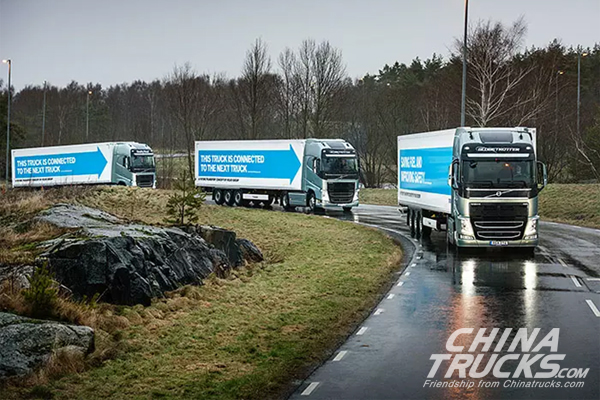
The current technology being tested is called platooning, which involves trucks from the same company synchronising their braking on motorways in order to drive far closer together than would be safe if they were reliant on human reaction times. Driving closer together reduces air resistance and allows for better fuel consumption.
Human drivers are still required to control the trucks, however, for example when truck platoons travelling on highways have to separate at junctions.
Several other barriers remain before trucks can shed their human drivers. One is agreement on the technology used in the trucks so they can “talk” to each other, which is particularly important given most hauliers have several brands of vehicle in a fleet.
Regulatory harmonisation between countries is also important so that trucks can pass smoothly across borders, says Erik Jonnaert, secretary-general of the European Automobile Manufacturers Association. “Otherwise we risk having a patchwork of rules and regulations, which could hinder manufacturers and road users from investing in automated vehicles.”
Connected trucks face particular risks, however. “GPS-spoofing to redirect trucks along with their freight is a very real threat for fleets using autonomous navigation systems,” says Philip Poulidis of BlackBerry Radar, a logistics management platform.
Finally, the trailers pulled by cabs need significant changes before they can function autonomously. Trailers, which can be changed between different cabs, will have to be fitted with sensors that allow the lorry to “see” behind it and that can operate with the self-driving system of any given truckmaker.
This, one industry executive says, could be the ultimate hurdle to clear in the technology’s eventual deployment. “If there are no sensors on the back, you would not want a truck driving itself,” the person says. “I do not think it would be safe.” (www.chinatrucks.com)
Views:0

Submit Your Requirements, We Are Always At Your Service.
- Driverless Trucks Debut at World Artificial Intelligence Conference 2019 2019-09-06
- Volvo's Driverless Trucks Begin Working at a mine in Norway 2018-11-29
- Beijing-Based Tusimple Racing Tesla Brings Driverless Trucks to Arizona 2017-09-08
- Driveless Truck 'Platoons' Head for Australia's Main Roads 2017-06-15
- 800+ Electric Heavy Trucks Head Overseas as SANY Sets New Export Record 2026-06-24
- Beiben Secures Order for 300 Electric Trucks in Cross-Border Logistics Project 2026-06-23
- FAW TRUCKS Secures Orders for 1,640 Trucks During Latin America Market Tour 2026-06-22
- Li Sheng Visits Brazil to Advance Localization of FAW TRUCKS 2026-06-18
- FAW TRUCKS Introduces CTB Battery Platform and New Electric Heavy-Duty Trucks 2026-06-03
- Ethiopian PM Highlights XCMG Electric Truck 2026-05-14
- Visiting Invitation: See What's New from Renault Trucks at IAA 2026
- China's Heavy Truck Exports Surge in June as Leading Brands Win Major Orders
- JAC Becomes Official Vehicle Partner of Ghana Football Association
- Xuzhou Launches International Communication Center to Boost Global Outreach
- FOTON, COSCO Shipping Launch Joint Venture to Strengthen Global Supply Chain
- Foton, COSCO Shipping Move to Secure Capacity as China’s CV Exports Rise
- The 11th DISCOVERY TRUST Awards Successfully Held in Beijing, China
- Chinese Heavy Truck Makers Shift to Value-Driven Global Expansion
- Shandong Heavy Industry and Kazakhstan’s Karaganda Region Ink New Deal
- China’s Diesel Trucks are Shifting to Electric

- China's New Energy Tractor Truck Sales Rise 97% to 25,000 Units in June
- China's Pickup Truck Sales Continue to Decline in May
- China's Tractor Truck Sales Up 27% in May
- China's Medium-Duty Truck Market Surges 74% in May
- China's Mini Truck Sales Drop 18% YoY in May
- China's Heavy Truck Sales Rise 23% in May
- China's Light Truck Market Grows 7% to 172,000 Units in May
- China’s Pickup Truck Market Posts Steady Sales Growth in April
- China Light Truck Sales Down 2% to 178,100 Units in April 2026
- China Heavy-Duty Truck Sales Hit 117,000 Units in April, Up 33% YoY