
AI-capable Supercomputer ZF ProAI: Maximum Computing Power and Flexibility
Friedrichshafen / Las Vegas. ZF unveiled the latest model of its automotive supercomputer ZF ProAI just before the start of this year’s Consumer Electronics Show (CES). The ZF ProAI RoboThink central control unit offers the highest performance of its kind in the industry. Vehicle manufacturers and mobility service providers additionally benefit from the system's modularity and scalability. Today’s four models in the ZF ProAI product family can be optimally configured for any application – from a basic ADAS function right up to fully autonomous cars, commercial vehicles and industrial applications.
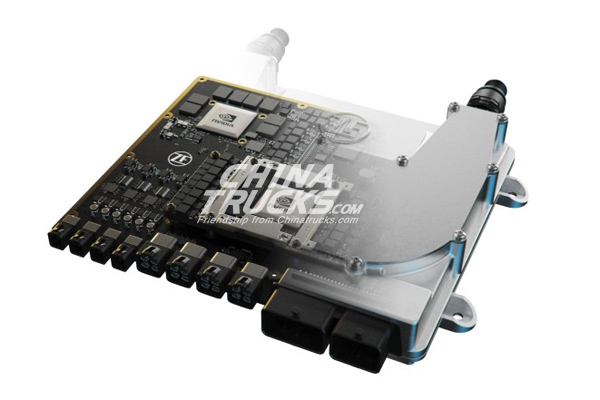
Customers can also specify their favorite software architecture – a real breakthrough, especially for Mobility-as-a-Service applications. In the wake of booming services such as ride hailing ZF also premiered its own software stack for new mobility concepts at the CES. This stack together with the latest ZF Pro AI and the company’s comprehensive sensor set represent a fully integrated system for driverless vehicles that can be easily adopted by the new players in the field of mobility services.
NVIDIA DRIVE Autopilot premieres on ZF ProAI
The power and flexibility of ZF’s ProAI also convinced NVIDIA to name ZF one of their preferred partners for the launch of their new Level2+ NVIDIA DRIVE AutoPilot. Since ZF’s new product’s volume production starts within the next 12 months it is the only automotive grade AI capable supercomputer that can meet NIVIDIA’s ambitious timeline for the launch of their DRIVE AutoPilot from the beginning. ZF’s CEO Wolf-Henning Scheider explained, “We are taking advantage of the fact that only ZF offers a supercomputer that is ready for volume production. Our open, flexible, modular and scalable ZF ProAI product family allows for just the right configuration of any application – for a variety of industries, and across all levels of automated driving.”
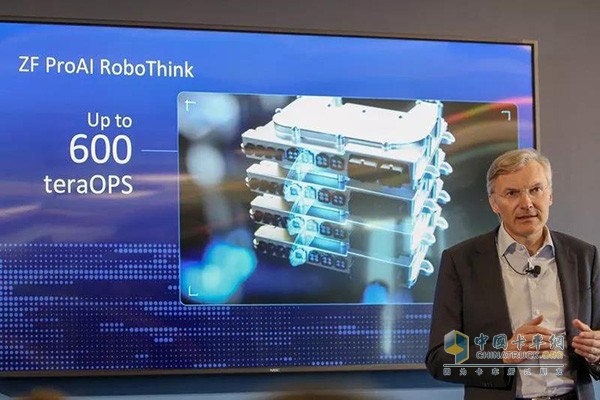
“We’re thrilled with the results of our collaboration with ZF. Their agility and system expertise has resulted in the incredibly rapid development of the ProAI platform enabling L2+ through L4/L5 robotaxi vehicles, leveraging NVIDIA’s DRIVE Xavier processors and DRIVE software,” said Rob Csongor, Vice President of Autonomous Machines, at NVIDIA. “ZF is now able to deliver to car makers advanced L2+ self-driving solutions for production starting in 2020 and the ability to quickly scale to higher levels of autonomy.”
ZF ProAI is a powerful alternative to closed systems
Greater processing power and artificial intelligence are important prerequisites for autonomous driving functions from Level 4 and higher. A high-performance processing unit is essential to analysing 360-degree environmental surroundings while monitoring the vehicle interior and position of the occupants to help enhance safety and vehicle control. The mobility industry can now benefit from the world's most powerful central processing unit in the automotive field: the ZF ProAI RoboThink is a completely new design from ZF. This latest generation in the ZF ProAI product family comes with its own graphics processor, offers a total computing performance of more than 150 teraOPS (the equivalent of 150 trillion calculation operations per second) and can be modularly combined with up to four units, corresponding to a total performance of 600 teraOPS.
"The unique selling proposition of the AI-capable ZF ProAI RoboThink is its modular hardware concept and open software architecture. Our aim is to provide the widest possible range of functions in the field of autonomous driving," explained Torsten Gollewski, head of ZF Advanced Engineering and general manager of Zukunft Ventures GmbH.
With four models, ZF can cover virtually the entire range of possible application scenarios and use cases. The ZF ProAI Gen1 is a cost-effective entry-level model that complies with virtually all NCAP 2022 standards. The ZF ProAI Gen2 has sufficient computing potential to enable partially and highly automated Level 2 and Level 3 driving. The next stage up, the ZF ProAI Gen3, offers broad modularity and can combine various chips on up to three performance boards. This should provide enough computing power for real time processing of the data required for automated driving up to Level 4. The latest model, the ZF ProAI RoboThink – with its scalable computing power and its own graphics processor – is the most powerful high-end solution and is ideally suited for autonomous driving applications from Level 4 and above.
The ZF ProAI product family offers an open platform for the customized integration of software algorithms – covering conventional functions as well as AI algorithms. What's more, they support various operating systems common in the automotive field, e.g. AutoSAR, Adaptive AutoSAR or QNX and will add further platforms as they are developed. The successful partnership with NVIDIA continues with the ZF ProAI RoboThink – however ZF also offers customers the option of equipping the ZF ProAI with processors from other manufacturers. A current example is ZF’s new partnership with Xilinx, a leader in adaptive and intelligent computing. ZF is integrating Xilinx’s Multi-Processor System-on-Chip (MPSoC) platform for data aggregation, pre-processing, and distribution to enable the scalability and flexibility required for various sensor and automated driving feature sets, while also providing low latency and high efficiency artificial intelligence computer acceleration. This approach is unique compared to other systems on the market which use a fixed combination of hardware and software architecture – a solution which can potentially limit functionality and add more cost.
ZF ProAI accelerates Mobility-as-a-Service
Robo-taxis and autonomous people or cargo-movers are vastly accelerating the development of central control units with much higher computing power. This is because powerful domain computers used in Mobility-as-a-Service applications not only manage the complex calculation of the surroundings based on a fusion of camera, radar and LIDAR data, they also integrate user data via the Cloud, payment systems and above all optimal route planning and implementation. Complex algorithms calculate these from the mobility and transport requirements of people or goods and can compare them in real time with the current traffic situation.
"The computing power of central computers in robo-taxis and autonomous people or cargo-movers will be significantly higher than for automated-driving passenger cars," says Torsten Gollewski. "The demand from ride-hailing service providers for even more computing power has arisen much sooner than predicted. Today, the autonomous-driving market is being driven more by new mobility service providers than by established vehicle manufacturers."
Depending on the use case, the ZF ProAI product family offers computing power that provides an ideal platform for the fusion of sensor data from cameras, LIDAR and radar systems. The people and cargo mover which ZF will launch in volume production this year in a joint venture with e.GO Mobile AG will also use ZF ProAI for its automated driving functions and networking.
Views:0

Submit Your Requirements, We Are Always At Your Service.
- ZF Adds New Truck Transmission Production Line in Germany 2025-08-05
- Farizon Auto Sets Roadmap for Global Expansion 2024-09-26
- IAA 2024: ZF, Foton Expand Partnership to Hybrid Transmission for China Market 2024-09-17
- IAA 2024: ZF Further Expands Its Position as a Pacesetter of the CV Industry 2024-09-17
- TraXon 2 Hybrid, Hybrid Transmission by ZF to Be on Display at IAA 2024-09-11
- ZF, Farizon Sign Cooperation Agreement on New Energy Commercial Vehicles 2024-07-09
- Tan Xuguang: Shandong Heavy Industry to Strengthen Strategic Cooperation with ZF 2024-04-24
- ZF Receives Approval for Level 4 Autonomous Driving Test in Shanghai, China 2024-02-21
- Auto Shanghai: ZF Presents Cutting-edge Tech for Software-defined, Automated EVs 2023-04-19
- ZF Wins Major Business: E-Drives and ProAI Supercomputer Apps for CVs at IAA 2022-09-20
- Visiting Invitation: See What's New from Renault Trucks at IAA 2026
- China's Heavy Truck Exports Surge in June as Leading Brands Win Major Orders
- JAC Becomes Official Vehicle Partner of Ghana Football Association
- Xuzhou Launches International Communication Center to Boost Global Outreach
- FOTON, COSCO Shipping Launch Joint Venture to Strengthen Global Supply Chain
- Foton, COSCO Shipping Move to Secure Capacity as China’s CV Exports Rise
- The 11th DISCOVERY TRUST Awards Successfully Held in Beijing, China
- Chinese Heavy Truck Makers Shift to Value-Driven Global Expansion
- Shandong Heavy Industry and Kazakhstan’s Karaganda Region Ink New Deal
- China’s Diesel Trucks are Shifting to Electric
- China's New Energy Tractor Truck Sales Rise 97% to 25,000 Units in June
- China's Pickup Truck Sales Continue to Decline in May
- China's Tractor Truck Sales Up 27% in May
- China's Medium-Duty Truck Market Surges 74% in May
- China's Mini Truck Sales Drop 18% YoY in May
- China's Heavy Truck Sales Rise 23% in May
- China's Light Truck Market Grows 7% to 172,000 Units in May
- China’s Pickup Truck Market Posts Steady Sales Growth in April
- China Light Truck Sales Down 2% to 178,100 Units in April 2026
- China Heavy-Duty Truck Sales Hit 117,000 Units in April, Up 33% YoY