
BYD’s Truck Chief Confident About Future Battery-Electric Trucks's Growth
The question of truck fleets converting to electric vehicles is a matter of “when, but not if,” according to Andy Swanton, vice president of truck sales at BYD, the Chinese company building electric commercial vehicles in a factory north of Los Angeles.
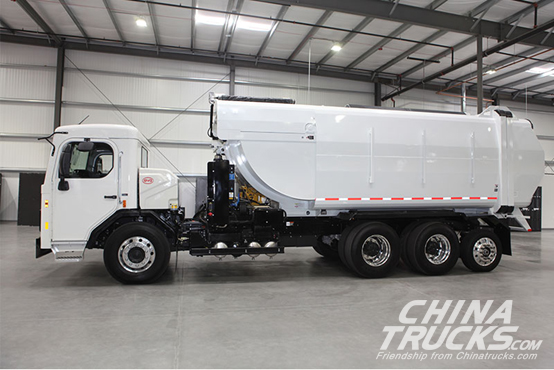
Much of BYD’s recent expansion – the company plans to add an additional 700 workers to support production of as many as 1,500 battery-electric buses annually – is focused on people haulers. But in an interview with Trucks.com, Swanton said that BYD’s global manufacturing capabilities and environmental policies from regions such as California, will foster the growth of electric trucking. Here’s an edited version of the conversation:
How have BYD’s Chinese roots affected its U.S. growth?
Around 2015 China implemented very strong purchase incentives both at the central and provincial government levels. In the last few years about 100,000 transit buses per year are being produced, and BYD has the highest market share for the larger buses. The scale has been really impressive. It’s a combination of stronger fiscal incentives with stronger government mandates.
And that certainly helps BYD globally, because now we’re manufacturing in the thousands, tens of thousands and hundreds of thousands on the vehicle side, which is helping us get more manufacturing volume and decrease price by manufacturing things at scale.
China just announced a goal to deploy 2 million zero-emission vehicles per year starting in 2020. This will drive hundreds of thousands of truck deployments in our overseas market and will bring down the price for the trucks we offer here in North America.
What can the U.S. learn from the development of the electric vehicle market overseas?
What we’ve learned in China and places like Norway is when vehicles make fiscal sense, when the vehicles are either at cost parity or you can make the financial argument that there’s a return on investment, then both consumers and private fleets will move towards purchasing. We believe that’s going to be the case in North America as well.
Trucking is a financially motivated market. Once we can prove that the financial case is there and that it works, you’re going to see hockey stick-like growth. It’s just a matter of when that comes to pass. I do think a lot of the regulations that will be set in place, not just in North America but in the global markets, are going to help us get there.
Do you sense that the U.S. electric vehicle industry has reached a critical mass yet?
I think it’s too early. Broadly in North America [electric] passenger car sales are about 1 percent of all purchases, and in California specifically it’s about 3 percent. You’ve seen a leveling off in recent years, so there’s a question of whether most of the folks who would be interested in electric vehicles have already purchased and now you need to address more of the mass market.
The other very developed industry would be transit. Between BYD, Proterra and the incumbents like New Flyer, everyone is coming to market with zero-emission solutions for every form of coach and bus on the roads. But, in terms of overall sales it’s still a smaller subset of the population. It increases every year, but we’re certainly lagging behind China, which already has a 20 percent market share for electric transit buses. It’s about 5 percent in the U.S. now, though it should be increasing to 10 percent — and possibly as high as 20 percent — in 2018.
What needs to happen for the industry to really make progress in the U.S.?
We typically talk about our barriers in three categories. There’s the price. There are savings with every vehicle that we deploy in fuel and maintenance costs, but fleets want to see a three-year payback, not an eight-year payback. So we need to bring our price down, or there needs to be a policy with regularly available, recurring incentives to present the financial case.
The second is infrastructure. For passenger cars there’s a question of where are you going to charge, and how long is it going to take to charge? In terms of larger commercial vehicles, infrastructure is also a hurdle because many North American policies regarding utility rate analysis and upfront cost of installation aren’t intended for large-scale electric vehicle deployment. And we need more standards put into place, like charging standards.
The last one is, in North America there’s a question of will the technology work? That’s something we’re up against with every customer and market. BYD has deployed hundreds of thousands of electric vehicles, and so we stand behind our technology. Unfortunately, there’s a long history in the U.S. dating back 10 years with companies who previously deployed this technology and fleets had a mixed experience.
Where is the strongest support for your products coming right now?
Certainly we’re furthest along with our transit markets, what we call coach and bus. BYD already had developed a lot of the transit technology driven by our Chinese markets. Also, the market lends itself to electric vehicles because we’re talking about defined urban duty cycles with lots of starts and stops. Lastly, transit fleets are often run through municipalities. We need the assistance of government, and in transit we have a unique opportunity to work through elected leaders who want to see zero-emissions technology brought to market and want to see air quality improve.
What are the current challenges in the trucking electric vehicle space?
On the truck side the biggest barrier right now is price. But we’re doing a lot. The truck market is over 100 times larger than the bus market in North America, so at BYD we’ve been very strategic in terms of targeting the markets that we think make sense. We’re demonstrating vehicles in the delivery market, in the goods movement space — mostly at port environments — and in the refuse space. All these projects will prove that this technology works, and then it will fall to BYD to get the orders that are going to help us reduce cost.
I think the question of whether fleets will transition to zero emission is more a question of when but not if. BYD is in a very unique position having the entire supply chain within the company and also having the financial resources to scale very quickly in response to it. (www.chinatrucks.com)
Views:0

Submit Your Requirements, We Are Always At Your Service.
- BYD Delivers 100 T75 Electric Light Trucks to Mexico 2026-06-10
- BYD Debuts Full Product Portfolio at 2026 Greater Bay Area Auto Show 2026-06-01
- BYD Launches T35 Electric Light Truck in Singapore 2026-03-27
- BYD Showcases Electric Commercial Vehicle Lineup at Shenzhen CV Eco Expo 2026-03-24
- BYD to Make Its Debut at China Commercial Vehicle Show(CCVS) in Wuhan with T4 2025-11-05
- BYD Rolls Out the 10,000th T5 Electric Light Truck 2025-09-04
- BYD Electric Sanitation Trucks Serve at September 3 V-Day Parade in Beijing 2025-09-03
- Top Chinese Pickup Brands in Overseas Markets in 2025 2025-06-16
- BYD SHARK Makes a Big Splash at Bolivia's Expo Auto 2025 2025-03-31
- BYD Unveils 2025 T5 Light Truck Series at Shenzhen Commercial Vehicle Expo 2025-03-05
- Visiting Invitation: See What's New from Renault Trucks at IAA 2026
- China's Heavy Truck Exports Surge in June as Leading Brands Win Major Orders
- JAC Becomes Official Vehicle Partner of Ghana Football Association
- Xuzhou Launches International Communication Center to Boost Global Outreach
- FOTON, COSCO Shipping Launch Joint Venture to Strengthen Global Supply Chain
- Foton, COSCO Shipping Move to Secure Capacity as China’s CV Exports Rise
- The 11th DISCOVERY TRUST Awards Successfully Held in Beijing, China
- Chinese Heavy Truck Makers Shift to Value-Driven Global Expansion
- Shandong Heavy Industry and Kazakhstan’s Karaganda Region Ink New Deal
- China’s Diesel Trucks are Shifting to Electric


- China's New Energy Tractor Truck Sales Rise 97% to 25,000 Units in June
- China's Pickup Truck Sales Continue to Decline in May
- China's Tractor Truck Sales Up 27% in May
- China's Medium-Duty Truck Market Surges 74% in May
- China's Mini Truck Sales Drop 18% YoY in May
- China's Heavy Truck Sales Rise 23% in May
- China's Light Truck Market Grows 7% to 172,000 Units in May
- China’s Pickup Truck Market Posts Steady Sales Growth in April
- China Light Truck Sales Down 2% to 178,100 Units in April 2026
- China Heavy-Duty Truck Sales Hit 117,000 Units in April, Up 33% YoY